CHILL VENT TECHNOLOGY IN MOULD DESIGN: REDUCING POROSITY IN HIGH-PRESSURE DIE CAST COMPONENTS
The challenge: porosity in aluminium die castings
High-pressure die casting (HPDC) is a manufacturing process in which molten aluminium is injected into a steel mould at high speed and pressure.
The cavity of the mould fills in mere milliseconds. A consequence of this rapid filling is porosity – small voids or bubbles trapped inside the solidified metal.
Porosity arises from 2 main sources:
-
gas porosity, caused by air and gases that cannot escape from the mould quickly enough during injection, and
-
shrinkage porosity, caused by uneven cooling and solidification of the metal.
In a standard mould without advanced venting, porosity can account for 3 – 5% of the casting volume, leading to reduced mechanical strength, pressure-tightness failures, cosmetic defects, and higher rejection rates.
Common problems in post-treatment of these components include porosities becoming visible during machining (especially milling) or porosities impacting the finishing of the product (coating or other surface treatments).
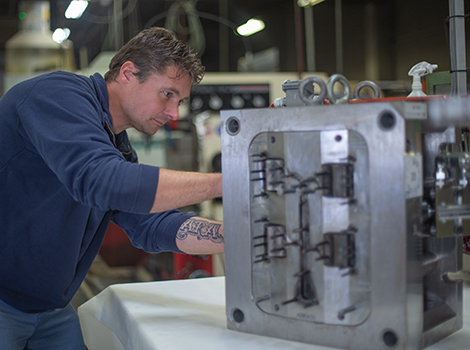
What is a chill vent or washboard?
A chill vent – also referred to as a washboard – is a specially designed insert built into the mould at the end of the metal flow path. It consists of 2 interlocking blocks with a corrugated (wave-like or zigzag – hence the term washboard) gap between them, resembling the ridges of a traditional washboard.
This narrow, labyrinth-shaped channel serves a dual purpose:
it allows trapped air and gases to escape freely from the mould cavity, enabling more substantial evacuation of air in a very short time;
while simultaneously freezing (solidifying) any molten metal that enters the channel, preventing it from blowing through to the outside of the mould.
The result is a controlled, self-sealing vent that dramatically improves casting quality.

Material choice: beryllium copper (CuBe) inserts
The effectiveness of a chill vent depends critically on its material. Our premium mould tool steel (Uddeholm Orvar Supreme) has a thermal conductivity of approximately 27 W/m·K. Washboard inserts are manufactured from beryllium copper alloy, which offers a thermal conductivity of approximately 240 W/m·K – almost 9 times higher than tool steel.
This dramatically faster heat extraction means that molten aluminium entering the corrugated channel solidifies almost instantly upon contact with the washboard surfaces. The rapid freezing prevents metal blow-through, and crucially allows the designer to use a wider venting gap (typically 0.8 – 1 mm versus 0.05 – 0.1 mm for conventional vents), which in turn evacuates significantly more trapped gas per unit of time.

Chill vent manufactured by InterGuss.
Impact on the casting process and quality
Incorporating chill vents into the mould design addresses porosity through 5 complementary mechanisms:
- Gas evacuation: the corrugated channel provides a large surface area and a wider gap than flat vents, allowing trapped air to escape efficiently during the milliseconds of cavity filling. Studies show that optimised venting can reduce gas porosity by up to 80%.
- Contaminant capture: the first metal to reach the end of the flow path is typically the coldest and most contaminated with oxides (a thin layer of aluminium oxide that forms on contact with air). Overflow wells and chill vents capture this “first-to-arrive” metal, preventing oxide inclusions from remaining in the finished part.
- Thermal balance: washboards help regulate the temperature distribution across the mould. Uniform thermal conditions reduce the risk of hot spots (localised areas that cool last), which are the primary cause of shrinkage porosity and surface defects such as cold shuts (visible lines where two metal flow fronts meet without fully fusing).
- Consistent venting reliability: conventional flat vents are susceptible to progressive clogging as metal debris and oxide deposits accumulate over production runs, gradually reducing their effectiveness. The corrugated geometry of a chill vent, combined with the self-sealing freeze-off action, maintains stable and repeatable gas evacuation throughout the service life of the mould.
- Compatibility with forced (vacuum) venting: the chill vent design is fully compatible with vacuum-assisted die casting systems, in which a vacuum is actively applied to the mould cavity to extract residual gas prior to and during injection. When combined with vacuum venting, the washboard serves as a controlled interface point that prevents vacuum loss while maximising gas removal – enabling the production of castings with the lowest achievable porosity levels, including heat-treatable and weldable grades.

Improved porosity levels (right picture).
The net result is a casting with very low porosity levels, typically 1% by volume or even lower, significantly improved mechanical properties, and better surface finish – directly translating to lower scrap rates and higher first-pass yield in production.
Cost implications
The inclusion of washboard inserts increases the mould cost for 2 reasons:
- the beryllium copper material itself is substantially more expensive than tool steel, and
- the corrugated geometry requires additional precision machining of the insert blocks.
However, this investment is recovered through fewer rejected castings, reduced rework, less downtime for quality interventions, and the ability to meet tighter quality specifications (such as pressure-tightness).
For components with high geometric complexity – where gas entrapment risk is inherently elevated – chill vent-equipped moulds represent the engineering best practice. They are the standard approach specified by leading automotive and electronics OEMs.

Our approach to mould design
We believe a mould quotation should reflect what is technically required to produce your component at the quality level it demands – not what is needed to win a price comparison. If our engineering assessment shows that washboard inserts are necessary, we will include them, and we will explain exactly why.
In case of doubt, design choices can be made to introduce additional chill vent technology in the mould at a later stage. This design choice should be taken from the start though, or chances are it cannot be added at a later stage.
We would rather propose the right solution, than offer a lower price that creates problems downstream.
Every component has its own challenges – wall thickness variations, flow path complexity, functional requirements. We would welcome the opportunity to review your specific application to see if high-pressure die casting can provide benefits for the production of your product.
Contact us to schedule a technical consultation with one of our engineers.