Electronics in extreme environments
The conditions in which electronic equipment must operate are often challenging. Moisture and vapour, temperature fluctuations, dust, sand, smoke and even gases. All these harsh environments can have a detrimental effect on the lifespan and reliable operation of almost any electronic application.
Aluminium or zamak enclosures
Many electronics manufacturers choose high-pressure die-cast aluminium or zamak enclosures. These protect electronic components against impacts, offer excellent resistance to temperature fluctuations and provide electromagnetic shielding. The enclosures are durable, feel solid and robust, and offer a high-quality appearance and finish.
In addition, the enclosure acts as an efficient heat sink. Aluminium and zamak are good thermal conductors, while the high precision of our die-casting process allows us to produce thin cooling fins. The considerable design freedom also makes it possible to direct airflow and optimise heat dissipation.
Pedeo and Ninix: the perfect partnership for sealing complex die-cast components
For die-cast components with complex three-dimensional geometries, we rely on the material expertise and specialist knowledge of our partner Ninix.
Ninix and Pedeo share the same values and vision, making our collaboration a natural fit. Above all, together we develop the best solution for your project: a robust aluminium or zamak enclosure, perfectly sealed and capable of withstanding the most extreme conditions. An ideal solution for a long service life.
Alongside heat dissipation, electromagnetic shielding and mechanical strength, effective sealing is essential to ensure optimal protection of your electronics.
The die-cast component
Optimal sealing results from a carefully balanced interaction between the die-cast component, the sealing material and the sealing technique.
The cast-in groove
The sealing groove is integrated directly into the component during the die-casting process. Thanks to the smooth as-cast surface and precise casting tolerances, a cast-in groove is usually sufficient to achieve an excellent seal.

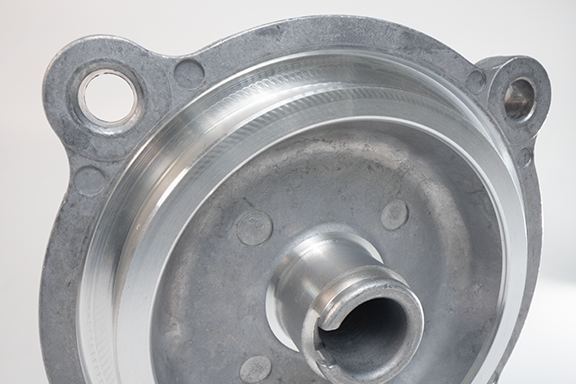
The CNC-machined groove
For a specific geometry, an exceptionally smooth surface or even tighter dimensional tolerances, it can be beneficial to machine the sealing groove after casting. CNC machining also allows us to achieve a specified surface roughness or even create a particular surface pattern, such as concentric circles.
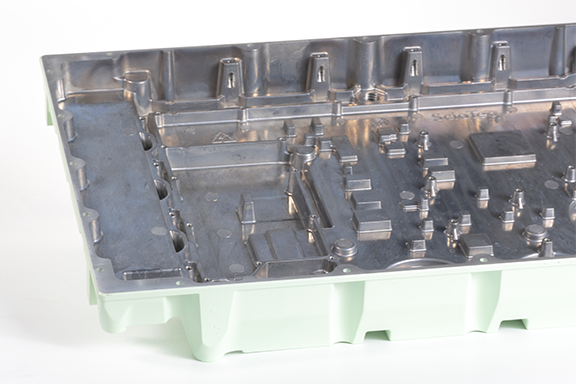
Without a sealing groove
A flat gasket can be placed directly onto a flat flange of the die-cast component, which may be machined to achieve an even smoother surface. By carefully positioning the cast-in screw holes, we ensure uniform compression of the gasket.
Sealing solutions

Standard seals and gaskets
A flat or round seal is placed directly onto the die-cast component or into a groove, either bonded or secured during assembly. An ideal solution for simple geometries.
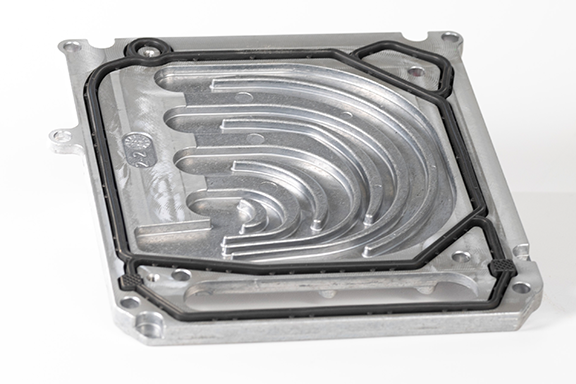
Custom-moulded or die-cut seals, with or without self-retaining features
We have seals manufactured in the required shape, either by moulding or die-cutting. They can also be equipped with small retaining tabs that secure the seal within the groove.
This solution offers considerable design freedom and allows the dimensions of the die-cast component and the seal to be perfectly matched.
The seal has no starting or ending point, eliminating joints or seams that could otherwise be a disadvantage in certain applications.

Custom 3D robotically dispensed seals
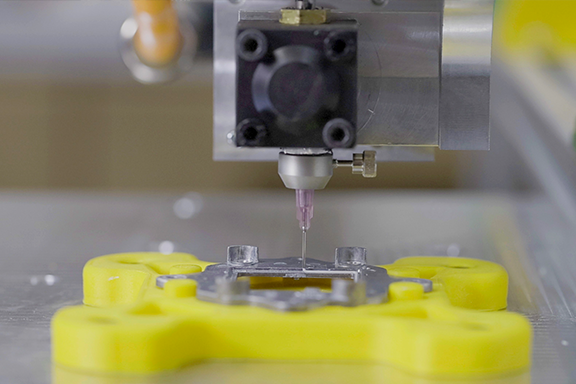
For complex die-cast components, we have the sealing material applied directly onto the casting using a CNC-controlled dispensing robot. This technique accommodates even the most intricate geometries, including three-dimensional shapes, offering virtually unlimited design freedom. The seal can be applied in multiple layers or in a specific profile, with exceptional precision and dimensional consistency throughout the entire production series.
The sealing material is dispensed directly onto the die-cast component, either onto a flat flange or into a groove. Plasma pretreatment ensures excellent adhesion, including over the long term. A wide range of sealing materials is also available, allowing us to select the most suitable solution for the specific environmental conditions the electronics must withstand.
Potting and electronic encapsulation
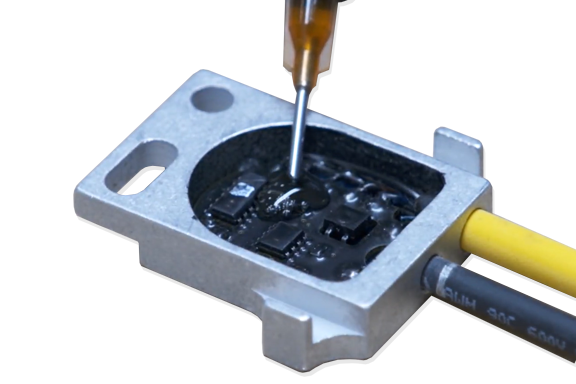
Potting is an advanced sealing technique in which electronic components are completely encapsulated in resin. This prevents external contaminants from reaching the electronics. However, heat dissipation through the enclosure becomes even more important, as the resin can restrict heat transfer. Fortunately, an aluminium or zamak enclosure acts as a natural heat sink.
Sealing solutions: a sustainable addition to your die-cast components
A high-pressure die-cast component with the right sealing solution extends the lifespan of your electronics, making it a sound choice in terms of sustainability. The longer a product continues to function reliably, the less waste it generates and the fewer new raw materials are required.
Aluminium and zinc also offer the advantage of being recyclable repeatedly without losing their inherent quality. Well-established collection and recycling systems ensure that a large proportion of die-cast components are actually recycled at the end of their service life. Compared with newly extracted raw materials, these recycled materials have a significantly lower environmental footprint and impact.
It is true that every additional material or treatment, whether a seal, a paint coating or a finishing process, can reduce the recyclability of the original materials. At Pedeo, we believe it is important to approach this responsibly.
That is why we continuously seek the best possible solution, consciously integrating sustainability into every decision we make.
Pedeo also takes care of sealing your enclosures
As a full-service supplier, Pedeo helps you select the right custom sealing solution from the very beginning of the design process. After all, optimal protection results from carefully considering the component geometry, material selection and sealing technique together.

Deel deze pagina


