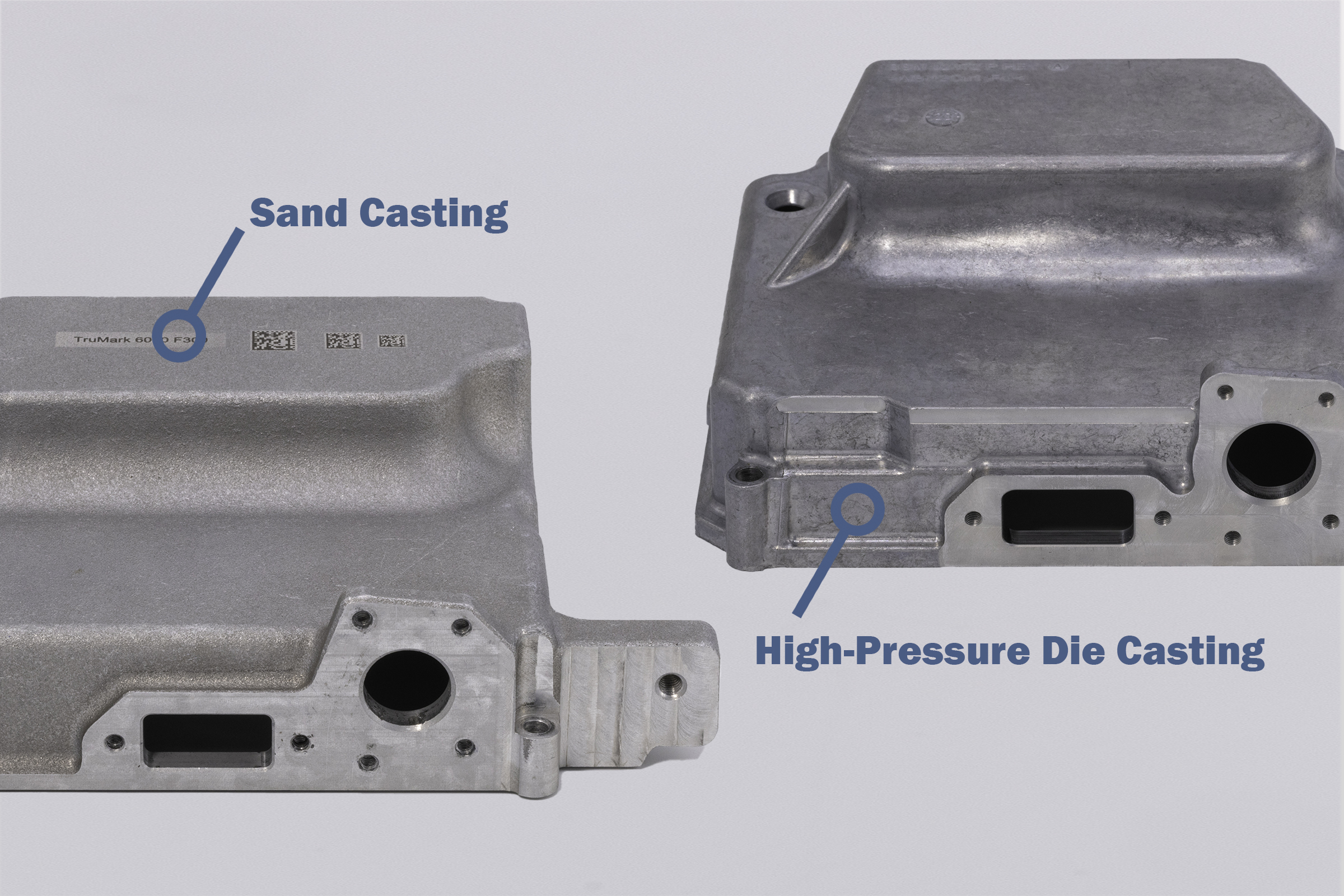
Redesign
Have you ever opted for sand casting despite dealing with a complex component? A part requiring tight tolerances and a high-quality surface finish? If so, redesigning the component for high-pressure die casting could deliver substantial cost savings. And we’re not talking about saving just a few cents. In some cases, switching from sand casting to high-pressure die casting can significantly reduce the number of production steps and finishing operations.
Fortunately, redesigning a component doesn’t mean starting from scratch. And you certainly don’t have to do it alone. Pedeo’s design engineers take care of most of the design work, using your existing sand casting as the starting point. We support you throughout the entire process, from initial design to series production.

The difference between sand casting and high-pressure die casting
Let’s start with the basics. Although both processes involve molten metal, there are some fundamental differences:
- In sand casting, molten metal is poured into a three-dimensional cavity shaped like the component, formed by two halves of a sand mould. Each casting therefore requires a new sand mould. This makes the process particularly suitable for smaller production runs.
- In high-pressure die casting, molten aluminium or zamak alloy is injected under high pressure into a steel die. After a very short solidification period, the casting is ejected and a new casting cycle begins. Thanks to its short cycle times, high-pressure die casting is ideal for larger production volumes.
These are two fundamentally different manufacturing processes for producing the same component. Each has its own characteristics, limitations and specific design requirements. Converting a sand-cast component into a high-pressure die casting therefore requires specialist knowledge and experience.
An exact copy? Or room for improvement?
Would you like an exact copy of your existing sand-cast component? Or were compromises made in the original design due to the limitations of sand casting?
Thanks to the higher dimensional accuracy and superior surface finish of high-pressure die castings, converting from sand casting to high-pressure die casting can already significantly reduce machining time. In addition, the high pressure applied during the casting process allows for thinner walls, resulting in substantial material savings. And all this without compromising strength. By incorporating reinforcing ribs, you can achieve a component that is just as strong, but lighter and more streamlined.
In any case, there’s a good chance our engineers will identify interesting opportunities for optimisation during the design process. Naturally, these improvements are always developed in close consultation with you, fully in line with the principles of co-design.

From sand casting to high-pressure die casting: co-design in action
What does this mean in practice? Let’s take a closer look at an application from the automotive industry: a housing for the electronic components of an engine block.
On the left, the design of the sand-cast component; on the right, the high-pressure die-cast version.
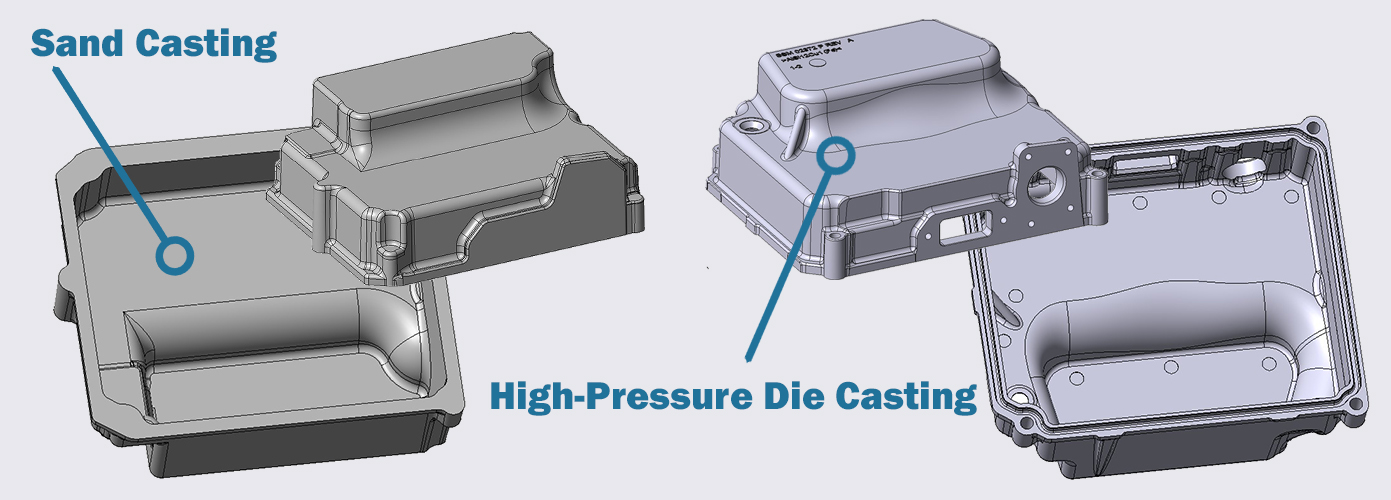
Advantages of high-pressure die casting
• Complex 3D geometries with fine details and tight casting tolerances.
• Integrally cast mounting bosses, openings, recesses, screw holes and sealing grooves. This is more efficient than adding these features during subsequent machining operations. Their positions also remain consistent, regardless of production volume.
• A smooth and uniform as-cast surface.
• Reinforcing ribs.
• Reduced wall thicknesses: lighter components and optimal use of raw materials.
• Text, symbols and logos integrated directly into the die.

Pedeo takes care of the entire process
When redesigning a component, Pedeo takes on most of the design work, using the original sand casting as the starting point. The result: faster production, fewer finishing operations and a superior surface finish. And this applies both to an identical reproduction and to an optimised design.
Curious about the advantages of high-pressure die casting for your designs? Whether it’s an existing sand-cast component or an entirely new project?
✉️ Contact us, we’ll be happy to help.
Deel deze pagina


